

When joint pain keeps limiting movement, exercise, work, or everyday activities, injections such as platelet-rich plasma and cell-based therapies often enter the conversation. That can create a difficult question: How does stem cell therapy vs PRP compare, and is one a better place to start?
There is no universal answer. PRP and therapies marketed as stem cell treatments are biologically different, preparation methods vary, and research is much stronger for some conditions than others. A person’s diagnosis, degree of joint damage, previous treatments, health history, goals, and tolerance for cost and uncertainty all matter.
The comparison can also become confusing because terms such as regenerative medicine, orthobiologics, stem cells, bone marrow concentrate, and PRP are sometimes discussed together even though they do not describe the same procedure.
For people considering regenerative approaches for joint pain, the most useful starting point is not choosing an injection. It is confirming what is actually causing the symptoms, how advanced the problem is, and what evidence exists for the specific treatment being considered.
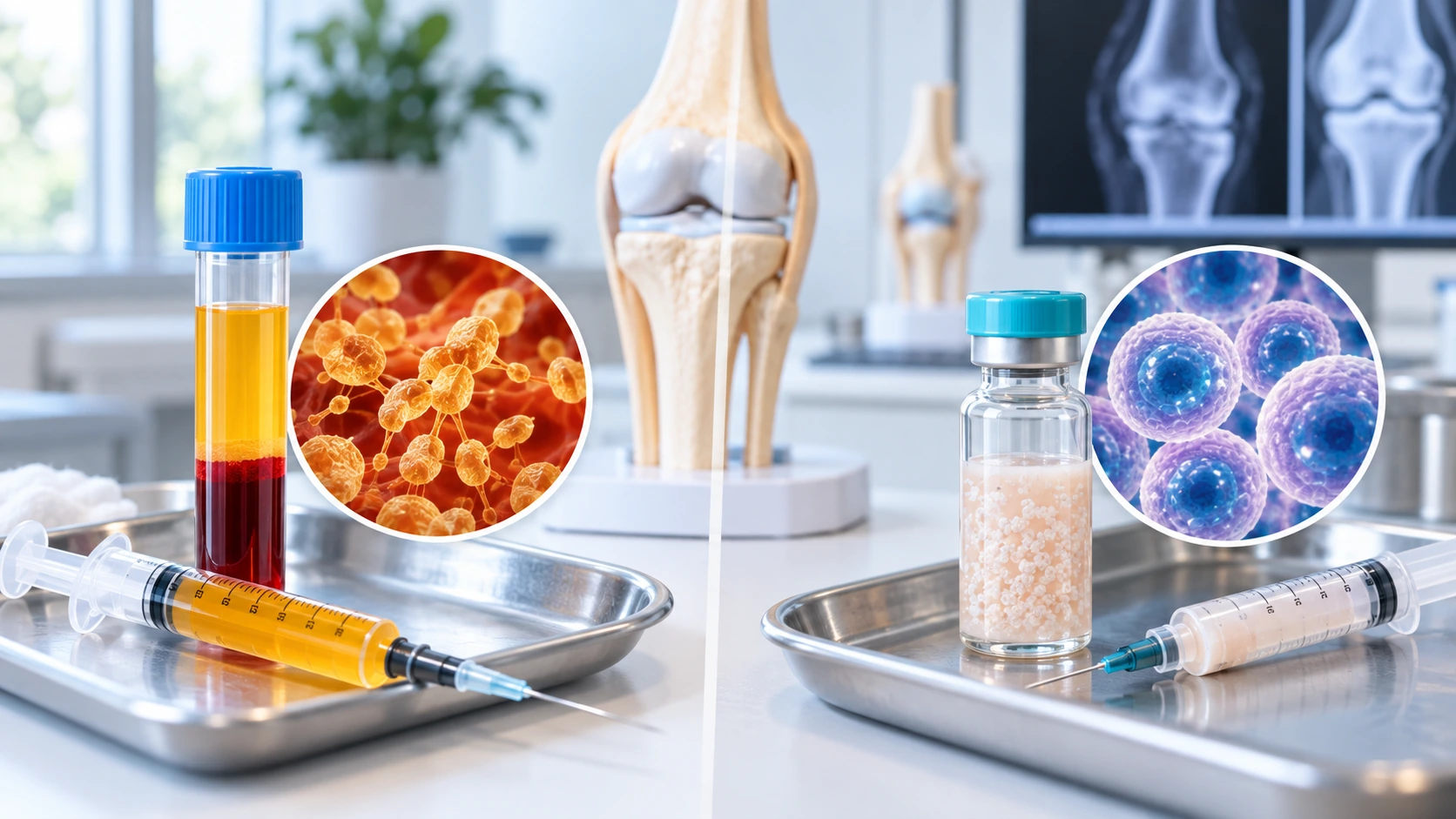
PRP and Stem Cell Therapy Are Not the Same Treatment
PRP is prepared from a person’s own blood. A blood sample is processed to create plasma containing a higher concentration of platelets. Those platelets contain proteins and signaling molecules involved in the body’s normal response to tissue injury. The composition of PRP can differ depending on the preparation system and whether white blood cells and other blood components are included.
“Stem cell therapy” is a much broader term. It may refer to bone marrow derived preparations, adipose tissue derived products, umbilical cord related products, or other cell and tissue products. These treatments cannot be assumed to have the same composition, regulatory status, biological activity, or clinical evidence.
That distinction matters when comparing results. A study evaluating bone marrow aspirate concentrate does not necessarily tell us how an unrelated birth tissue product will perform. Likewise, results from one PRP preparation may not perfectly predict outcomes from another PRP protocol.
The two approaches can therefore differ in several important ways:
- Where the treatment material comes from
- How the material is collected
- How much processing is involved
- What biologically active components are present
- How standardized the preparation is
- What research exists for the patient’s specific condition
- What regulatory requirements apply
- How much the procedure may cost
These differences are why broad claims such as “stem cells work better than PRP” or “PRP is always safer” are too simplistic.
Readers who want more background on these treatment categories can review Cendant’s regenerative medicine and stem cell therapy guide.

How PRP Is Prepared and Used
PRP begins with a blood draw. The collected blood is processed, commonly through centrifugation, to separate and concentrate platelets and plasma before the resulting preparation is injected into the target area.
Because the material comes from the patient’s own blood, PRP does not involve obtaining cells from donor tissue. Its relative simplicity is one reason PRP has become widely studied in musculoskeletal medicine.
The exact preparation, however, is important. PRP is not one completely standardized product. Platelet concentration, white blood cell content, total injection volume, activation method, and number of injections can vary between treatment protocols.
This variation makes research harder to compare. Two studies can both say they evaluated “PRP” while using preparations that are not biologically identical.
Research has examined PRP for conditions including knee osteoarthritis and certain sports related injuries, but outcomes are not identical across every diagnosis or preparation method.
For symptomatic knee osteoarthritis, the American Academy of Orthopaedic Surgeons states that PRP may reduce pain and improve function, although the strength of that recommendation is limited because the evidence has important inconsistencies.
A 2025 systematic review comparing PRP with placebo in knee osteoarthritis found evidence of modest improvement in pain during earlier follow-up periods, but the authors also reported substantial variation between studies and questioned the clinical importance of the benefit.
Another practical consideration is what happens after the injection. Depending on the condition and clinician’s protocol, patients may receive guidance about temporarily modifying activity and gradually returning to rehabilitation or exercise.
PRP should therefore be viewed as one possible component of an orthopedic treatment plan rather than a stand-alone solution for every source of joint pain.

What “Stem Cell Therapy” Can Mean in Orthopedics
One of the biggest difficulties in comparing PRP with stem cell therapy is that the term “stem cell therapy” is often used as though it describes one standardized treatment.
It does not.
Different preparations can come from different tissue sources and undergo very different collection and processing methods. Some orthopedic research involves bone marrow aspirate concentrate, commonly called BMAC. Other research involves cultured mesenchymal stromal cells. These should not automatically be treated as equivalent.
Even the biological contents of these preparations can differ substantially. A product described broadly as containing stem or stromal cells may also contain platelets, plasma, growth factors, immune cells, or other tissue components.
The FDA also distinguishes between different human cell and tissue products when determining how they are regulated.
For patients, the practical lesson is simple: ask exactly what product is being proposed.
Questions should include:
- Where does the material come from?
- Is it collected from the patient or a donor?
- How is it processed?
- Is the preparation minimally manipulated or substantially processed?
- What evidence exists for this specific preparation and diagnosis?
- What is its FDA regulatory status?
- What risks are associated with collecting, processing, and administering it?
- Is there evidence specifically for the joint or injury being treated?
These questions are especially important when a clinic uses broad phrases such as “stem cells” without clearly identifying the material being administered.
People considering treatment for arthritis should also understand their underlying condition. Cendant’s pages on osteoarthritis and joint arthritis provide additional condition specific context.

What Does the Research Say About Stem Cell Therapy vs PRP?
The clearest head-to-head research is concentrated around knee osteoarthritis. Even there, the evidence does not establish that one regenerative injection is universally superior.
A 2023 systematic review and meta-analysis comparing PRP, BMAC, and hyaluronic acid found no significant difference in post-injection outcome scores between PRP and BMAC among the studies analyzed.
A separate 2024 meta-analysis comparing mesenchymal stromal cell treatments with PRP found broadly comparable results across several commonly used knee outcome measures. PRP performed somewhat better on one outcome measure, but the authors cautioned that relatively few studies were available and that stronger research was needed.
These findings are useful, but they do not mean PRP and cell-based treatments are interchangeable. Study protocols differ considerably, and results for knee osteoarthritis should not automatically be applied to shoulder pain, hip arthritis, tendon injuries, spinal conditions, or other problems.
Research may also measure different outcomes. One study may focus primarily on pain, another on physical function, and another on changes seen on imaging. Improvement in one measure does not necessarily mean the underlying joint structure has been restored.
This distinction is particularly important when discussing cartilage. Reduced pain after an injection does not automatically prove that lost cartilage has regrown.
PRP vs Cell-Based Therapy at a Glance
| Comparison Factor | PRP | Cell-Based or “Stem Cell” Therapy |
|---|---|---|
| Source | Usually the patient’s blood | Depends on product and procedure |
| Main material | Concentrated platelets and plasma proteins | Varies by cell or tissue preparation |
| Collection | Standard blood draw | May involve bone marrow, adipose tissue, donor tissue, or another source |
| Standardization | Variable | Often highly variable |
| Research for knee OA | Moderate and growing, but inconsistent | Promising research exists, with significant uncertainty |
| Regulatory considerations | Depend on preparation, device, and intended use | Often more complex |
| Procedure burden | Usually involves a blood draw and injection | May require tissue harvesting or other preparation |
| Recovery considerations | Depend on diagnosis and protocol | Depend on tissue source and procedure |
| Cost | Varies by clinic and treatment protocol | Often affected by sourcing, harvesting, processing, and procedure complexity |
| Best candidate | Depends on diagnosis and clinical findings | Depends on diagnosis, product, evidence, and regulatory considerations |
For people specifically researching knee problems, Cendant provides additional information on knee arthritis and stem cell therapy for knee osteoarthritis.

FDA Status Is an Important Part of the Comparison
The regulatory distinction deserves special attention because marketing language around regenerative medicine can make treatments sound more established than they are.
The FDA states that regenerative medicine therapies have not been approved to treat orthopedic conditions such as osteoarthritis, knee pain, hip pain, shoulder pain, back pain, or tendonitis. The agency also states that the stem cell products currently approved in the United States are blood-forming stem cell products derived from umbilical cord blood for disorders affecting the blood-forming system, not orthopedic joint conditions.
FDA enforcement activity has continued against companies marketing certain unapproved human cell and tissue products for medical uses.
This does not mean every procedure discussed under regenerative medicine has the same regulatory status. It does mean patients should ask specific questions rather than relying on phrases such as “FDA registered,” “FDA compliant,” or “listed with FDA” as proof that a treatment itself has FDA approval.
The FDA specifically warns that registration of a company or listing of a clinical trial does not by itself establish that a regenerative product is legally marketed or FDA approved.
Patients should also distinguish between three separate questions:
- Is the clinic or manufacturer registered with the FDA?
- Is the product itself FDA approved for this medical use?
- Is the procedure being performed under a specific regulatory pathway or clinical investigation?
Those questions do not mean the same thing.
A clinician discussing a cell or tissue based product should be able to explain what is being administered and how the treatment fits within current regulatory requirements.

Should PRP or Stem Cell Therapy Be Tried First for Joint Pain?
For most people, the more important question is not “Which injection comes first?” It is “What is causing my joint pain, and what treatment pathway makes sense for that diagnosis?”
Joint pain can arise from osteoarthritis, cartilage damage, ligament injury, a meniscus tear, tendon problems, inflammation, trauma, or other causes. Treatment that makes sense for one problem may offer little value for another.
A person with mild to moderate degenerative knee changes, for example, presents a very different clinical situation from someone with severe joint destruction or an acute ligament injury.
Current osteoarthritis guidance continues to emphasize treatments such as exercise, self-management, appropriate weight reduction, and selected medications before more specialized options are considered. Treatment decisions should account for symptoms, function, medical history, access, cost, and patient preferences.
When a patient with an appropriate orthopedic diagnosis has already considered more established conservative options and wants to discuss orthobiologics, PRP generally has a clearer body of orthopedic evidence and involves a simpler autologous blood-based preparation than many treatments marketed as stem cell therapy.
That still does not make PRP the automatic first choice. Evidence differs by condition, and even knee osteoarthritis studies have produced inconsistent results.
A useful treatment sequence depends on questions such as:
- Has the diagnosis been confirmed?
- How severe is the condition?
- Have exercise or rehabilitation approaches been tried?
- Are medications appropriate?
- Is there a structural injury that may require another type of treatment?
- What does the evidence say about injections for this specific diagnosis?
- How important are cost and treatment burden to the patient?
- What outcome would count as meaningful improvement?
For patients with knee symptoms, understanding the signs, causes, and treatment options for knee arthritis can help place injection therapy within the larger treatment picture.
The Diagnosis Often Matters More Than the Injection
Two patients can both describe their problem as “knee pain” while having very different underlying conditions.
One might have gradual cartilage degeneration associated with osteoarthritis. Another may have a meniscus tear after twisting the knee. A third may have pain caused by a ligament or tendon problem.
Those differences affect treatment decisions.
Imagine an active adult who develops knee pain after a sudden change of direction during sports. Choosing an injection before determining whether the problem is a meniscus injury, ligament damage, cartilage injury, or another condition could delay a more appropriate treatment plan.
The same principle applies to chronic pain. A person may assume that worsening pain automatically means cartilage damage, even though pain can arise from several structures around the joint.
For activity related injuries, evaluating the type and severity of the problem should come before deciding whether PRP, another injection, rehabilitation, surgery, or a different approach deserves consideration. Cendant’s sports injuries information covers several conditions that can produce overlapping symptoms.
A proper diagnosis may involve:
- A detailed history of when symptoms began
- Physical examination
- Assessment of joint movement and stability
- Review of previous treatments
- X-rays when appropriate
- MRI or other imaging when clinically indicated
- Consideration of medical conditions that could contribute to pain
Without that information, comparing PRP and stem cell therapy can become an exercise in comparing treatments before the actual problem has been defined.

Who Might Be Considered for PRP?
PRP may enter the conversation for selected musculoskeletal conditions when symptoms persist despite appropriate conservative treatment and the diagnosis has been clearly established.
For knee osteoarthritis, AAOS acknowledges evidence that PRP may improve pain and function in some patients, but describes the recommendation as limited because research results and treatment protocols vary.
Factors a clinician may consider include:
- The actual source of pain
- Severity of structural joint damage
- Age and general health
- Activity level
- Previous treatments and response
- Medications and bleeding risk
- Expectations for treatment
- Whether rehabilitation will accompany the injection
Patient expectations deserve particular attention. PRP may be discussed as an attempt to improve symptoms and function in appropriate cases, but it should not be presented as a guaranteed method for rebuilding an arthritic joint.
The degree of arthritis may also affect the conversation. A person with earlier degenerative changes may have different treatment options from someone whose joint has advanced structural damage and major loss of function.
PRP is not a replacement for diagnosing the condition, and an improvement in symptoms does not necessarily mean damaged cartilage or other joint structures have been restored.
Cell-Based Treatments Require Additional Questions
Interest in cell-based therapies is understandable. Research into mesenchymal stromal cells, bone marrow preparations, and other biologic approaches continues, and some clinical studies have reported improvements in pain or function.
The evidence remains difficult to interpret because cell sources, preparation methods, doses, study populations, comparison groups, and outcome measures differ.
There is also a major difference between a promising research finding and an FDA-approved treatment for a specific orthopedic condition.
The FDA has reported serious adverse events associated with improperly marketed or unapproved regenerative medicine products, including infections and unwanted immune or inflammatory responses.
That makes product identification especially important.
Someone considering a cell-based treatment should know precisely what will be administered and should receive a clear explanation of the evidence, uncertainties, alternatives, possible risks, and regulatory status before proceeding.
It is also reasonable to ask how many actual stem or stromal cells are expected to be present in a preparation and whether that information is known. The label used in marketing does not necessarily tell a patient what biologically active cells or tissues are actually being injected.
Additional questions may include:
- Is the material autologous or donor derived?
- Is tissue harvesting required?
- Is local anesthesia used?
- What complications can occur at the collection site?
- How is contamination risk controlled?
- What follow-up is included?
- Is rehabilitation recommended afterward?
- What evidence supports this particular preparation for my condition?
Additional patient education about stem cell therapy for joint pain can help prepare questions for a clinical consultation.

Cost and Treatment Burden Can Change the Decision
Cost is another reason that comparing PRP and stem cell therapy by effectiveness alone can be misleading.
The total expense may depend on:
- The type of procedure
- How the biologic material is collected
- Processing requirements
- Number of injections
- Imaging guidance
- Facility charges
- Follow-up visits
- Rehabilitation
- Insurance benefits and exclusions
- Geographic location
Cell-based procedures that require tissue harvesting and additional processing may involve a different level of procedure complexity than a standard blood draw used for PRP.
The treatment burden can also extend beyond the injection itself. A patient may need to temporarily modify exercise, arrange transportation, attend follow-up appointments, or participate in rehabilitation.
Instead of comparing advertised prices alone, patients should ask for the expected total cost of the complete treatment plan.
That conversation should include what is covered if symptoms do not improve. Some clinics may recommend multiple injections or additional procedures, so patients should understand whether the quoted price reflects one treatment or an entire plan.
When payment options are relevant, Cendant provides information about financing.
Cost should also be weighed against uncertainty. Paying more for a procedure does not establish that it is more effective.
Questions Worth Asking Before Choosing Either Option
A useful consultation should leave you understanding much more than the name of the injection.
Consider asking:
- What is my exact diagnosis?
- What evidence supports this treatment for my specific condition?
- How strong is that evidence?
- What alternatives should I consider first?
- What exactly will be injected?
- Where does the material come from?
- How is it processed?
- What is the FDA regulatory status of the product or procedure?
- What benefits are realistic?
- What are the known risks and uncertainties?
- How quickly might symptoms change if the treatment helps?
- How will we determine whether treatment worked?
- What happens if my symptoms do not improve?
- What is the complete expected cost?
- Are additional injections commonly recommended?
- Will I need physical therapy or activity restrictions afterward?
- What symptoms after the procedure would require medical attention?
- At what point should another treatment option be considered?
A clinician who recommends an orthobiologic treatment should be able to discuss both the reasons for considering it and the limitations of the available evidence.
Patients should be cautious if a treatment is presented as appropriate for many unrelated diseases, if guaranteed results are promised, or if important questions about the product’s source and regulatory status cannot be answered clearly.
Comparing Your Options With the Diagnosis in Mind
The evidence does not support a simple rule that stem cell therapy is better than PRP, or that every patient should try one before the other.
PRP has been studied more extensively for several orthopedic applications, particularly knee osteoarthritis, but results remain variable. Cell-based therapies are also being studied, yet the category includes very different products and procedures, making direct comparisons difficult.
Current FDA guidance also remains particularly important when evaluating treatments marketed as stem cell or regenerative therapies for orthopedic conditions.
The more useful decision starts with three questions: What is causing the symptoms? What treatments have already been considered? What evidence supports the specific option being proposed?
From there, factors such as procedure complexity, expected recovery, cost, medical history, treatment goals, regulatory considerations, and the quality of available research can help shape a more informed discussion.
For some patients, PRP may deserve consideration because it uses the patient’s own blood and has a growing body of orthopedic research. For others, an injection may not be the most appropriate next step at all. Cell-based treatments require even closer attention to the exact product, available evidence, and regulatory status.
Cendant Stem Cell Center discusses PRP and cell-based approaches within its orthopedic treatment services. Patients who want to compare potential options can contact Cendant Stem Cell Center to discuss their condition and questions with the clinical team.